Sydney Convention and Exhibition Centre
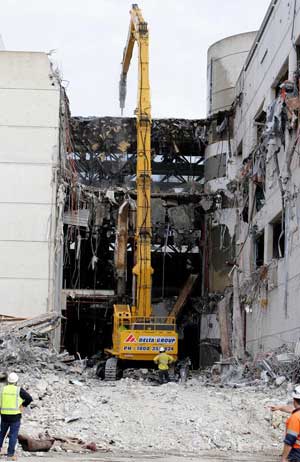
The showpiece of the Darling Harbour re-development project of the late 1980s, the Sydney Convention and Exhibition Centre was unceremoniously dumped and bulldosed in December 2013 to make way for a AU$3.4b redevelopment of Darling Harbour by the NSW Government. Its replacement - The International Convention Centre Sydney - is being promoted as Australia's first fully integrated convention, exhibition and entertainment precinct when it opens in December 2016, however the people of Melbourne might disagree - their Convention Centre opened in 2012 with a similar claim. The rivalry between Sydney and Melbourne is still alive and kicking!
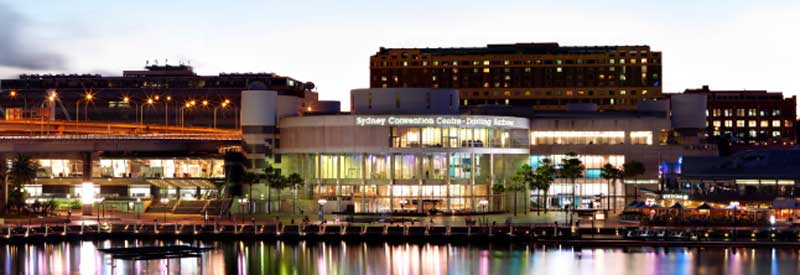
The Sydney Convention and Exhibition Centre was officially opened in 1988, with a new section of the centre added for the 2000 Summer Olympics. During those games, the venue played host to the boxing, fencing, judo, weightlifting, and wrestling competitions. The building was owned by the State Government of New South Wales, with the centre administration and business run by the Accor Hotel Group. The Sydney Convention and Exhibition Centre was used as a conference and convention venue and to hold exhibitions, as well as hosting various smaller events such as weddings and meetings. The Convention Centre had around 30 rooms, ranging from small meeting rooms to a 3500 capacity auditiorium, as well as foyer areas and other spaces which can be adapted for use as an exhibition space or pre-dinner function venue. The Exhibition Centre consisted of six halls, used primarily for exhibitions, but also for gala dinners and other large-scale events.
The Sydney Convention and Exhibition Centre was a key meeting venue of APEC Australia 2007 in September, 2007 when the political leaders of the 21 member states of the Asia-Pacific Economic Cooperation met. The venue was host to the Business Leader's Summit held in conjunction with APEC Leader's Week.

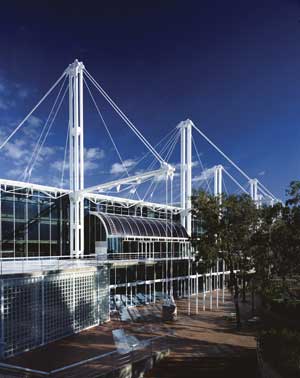
Phillip Cox designed the Exhibition Centre in the modernist style with multi-tiered glass surfaces over five interconnected halls with tall steel masts rising overhead in a maritime theme. The project took 36 months to complete and was built by the Darling Harbour Authority for the state government of the time. The building has been awarded several acclaims including the highly coveted Royal Australian Institute of Architects Sir John Sulman Medal in 1989 and MBA Excellence in Construction Award in 2007. It was met at one end with the John Andrews designed Sydney Convention Centre, semi-circular in appearance and quite an impressive building in its own right. Both served as venues for events during the Sydney 2000 Olympics, both were regarded as quintessentially Sydney buildings.

Architect Phillip Cox rightly slammed the government's redevelopment plan as "an act of vandalism." Fellow architect John Andrews, who designed the Convention Centre, also criticised the decision to demolish such a relatively young set of buildings, a decision which had been made on the premise that Sydney needs world-class facilities to more effectively compete for large events, and the existing buildings were too small to meet demand. "Does it make sense to pull down $120 million worth of (building) that's perfectly all right? ... As Australia, we just haven't grown up, we haven't developed any good manners and we don't protect and look after our good things. I don't understand why the (new) architects and are so keen to knock everything down," he said. "Why don't they just reuse things and add to them?" To add insult to injury, Andrews only found out about the proposed demolition through reading a newspaper article.
Former public works minister Laurie Brereton, who oversaw much of the original Darling Harbour redevelopment in the 1980s, branded the new project "the work of Philistines." Docomomo Australia, an organisation that is dedicated to the 'documentation and conservation of buildings, sites and neighbourhoods of the modern movement' went one step further in their criticism. They nominated the Darling Harbour site to the International Council on Monuments and Sites, for a heritage alert, the first time ever for an Australian site. Docomomo Australia vice-chairman Scott Robertson said Darling Harbour was "one of the finest modernist collection of buildings in Sydney", and likened the government's plans to that of Russian president Vladimir Putin, who also made the heritage alert list over his treatment of developments threatening heritage sites in Russia.